Gender Performance and Self-Fashioning
My Tender MatadorGender Performance and Self-Fashioning is not merely a matter of appearance for the Queen of the Corner: it becomes a practical, expressive means of moving through a society where queer identity invites humiliation and danger. Her feminine presentation can protect her, give her a voice in public, and assert a self the authorities would rather discipline. Yet the same self-fashioning is shadowed by social stigma and unrequited love, so that performance offers neither simple freedom nor an escape from vulnerability.
Performance as Tactic and Voice
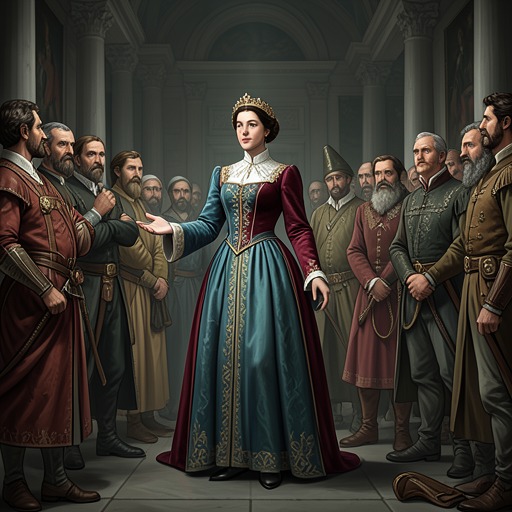
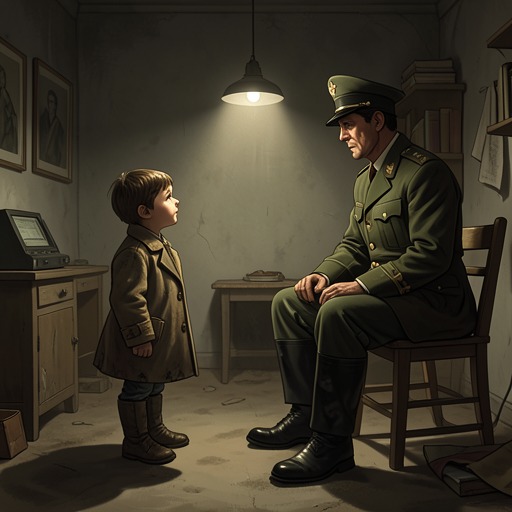
When soldiers separate passengers into groups of men and women, the Queen is momentarily unsure where to go. The photograph of a disappeared person remains in her pocket, and a wrong move could expose her. She responds by bringing forward what she calls her emergency drag queen: she jokes that she would have to split herself in two to be in both places at once. Rather than submit to the soldier’s attempt to classify her, she redirects the encounter with quick, playful answers. She says she embroiders tablecloths for generals’ wives and sheets for a colonel’s mother, turning the domestic labor that supports her life into a deflecting script. The soldier lowers his weapon and lets her continue without searching her. Her performance does not dissolve the danger, but it helps her pass through it.
The scene makes gendered legibility a matter of immediate consequence. The soldiers’ division assumes that every passenger can be sorted into one of two categories; the Queen’s wit exposes the strain in that assumption while also exploiting the discretion of the person enforcing it. Her femininity is neither presented as a disguise she can simply take off nor as a guarantee of safety. It is a practiced social resource, useful in a narrow moment, under conditions she does not control. Her movement away from the checkpoint remains anxious: she imagines surveillance, worries that the Front’s refuge may be exposed, and fears that the soldiers might suspect her precisely because they have let her pass.
Appearance, Memory, and the Imagined Self
The Queen’s personal belongings preserve versions of herself that the present cannot fully sustain. As she prepares to leave her home, she gathers the embroidered tablecloth, yellow hat, polka-dot gloves, cat’s-eye sunglasses, old magazines, and a photograph of herself in drag. The photograph shows her in a mermaid dress with a carefully arranged chignon, makeup, and a slender silhouette. Looking at it, she judges herself almost beautiful: the image’s age and softened outline make it possible to admire a glamour she feels has been lost. The photograph is not simply a record of clothing. It lets her encounter a past self as an object of attention and imagine how she might have appeared to Carlos.
That imagined audience shapes the fantasy. The Queen wonders whether Carlos, seeing her in the old portrait, might have loved her with the ardor she longs for. She pictures the two of them leaving together, travelling toward the horizon, and stopping in a village where she could loosen her hair and offer him a kiss. The fantasy gives her a scene in which her appearance is received as desirable rather than mocked or rejected. But the imagined romance remains counterfactual: the portrait cannot change Carlos’s feelings, and the glamour of the past cannot prevent the political separation now under way. The mirror of the present, by contrast, brings her back to a face marked by hardship. Self-fashioning offers a cherished image and a private imaginative refuge, but not the power to make that image come true.
Stigma, Public Speech, and Political Belonging
The Queen’s gender expression is also a source of exposure in public space. On a bus, she challenges a passenger who condemns young people for protesting and striking. Although she admits to herself that she has never been involved in politics, she says that the country is not as the government describes it: soldiers are everywhere, and explosions and gunfire have made sleep difficult. Students applaud her. She is surprised and frightened by her own words, then takes pride in having spoken and imagines Carlos approving of her courage. Her public voice emerges through a moment of self-surprise rather than a declared political identity.
Elsewhere, police hostility makes clear the cost of being read as queer. At a demonstration in central Santiago, an officer strikes her when she bends to pick up a leaflet calling for 1986 to be a year of liberation and declaring that Pinochet will fall. She feels humiliation as well as pain, and her anger turns toward the regime’s violence. Soon afterward, she joins women gathered at the cathedral, holding photographs of relatives who have been arrested and disappeared. A young woman invites her into the group; the Queen takes a placard and adds her voice to the demand for justice. Among the women, she does not feel embarrassed by her high-pitched voice. The solidarity is brief—police sirens drive the demonstrators away—but she carries the photograph with her, carefully folding it and putting it in her pocket. Her feminine voice, previously a marker by which others could demean her, becomes part of a collective act of witness.
These episodes connect gendered exclusion with political coercion without making the Queen’s experience identical to that of the relatives of the disappeared. She is beaten and threatened as a queer person, while the women’s placards speak to the loss of family members and the state’s refusal to account for them. The scene nevertheless gives her a place in their public gathering: she can stand beside them, hold a photograph, and speak in a voice she does not have to suppress. In this moment, belonging is created by action and shared protest, not by conforming to the assumptions that govern gender or citizenship.
Performance Under Repression and Forced Departure
The Queen’s final preparations show how style, memory, and survival converge when remaining in Santiago becomes too dangerous. Laura tells her that the other safe houses have been searched and that hers will be next; the secret police may arrive within hours. The Queen resists leaving the home she has made, but the decision is presented as necessary both for her own safety and for the safety of others. She is told to remove names, letters, documents, and any other clues that might be found. In response, she burns address books and papers, cleans surfaces, and packs what she cannot bear to abandon into two bags.
Among the packed possessions, the photograph of her former drag self sits alongside the yellow hat and other cherished objects. She is not simply maintaining a public look: she is carrying fragments of a personal history into an uncertain future. The contrast between the idealized image and her present reflection makes the photograph a keepsake of both self-recognition and longing. It allows her to say that she was once pretty, while the fantasy that Carlos might have loved that version of her reveals how strongly her sense of desirability remains tied to his imagined gaze.
Before leaving, she takes her belongings and unfinished work to La Rana, also affectionately called Mama Rana, and leaves her the radio and the sheets she did not finish, so her friend can earn money from the work. When La Rana asks why she is going, the Queen can say only that it is a matter of life and death. She embraces her friend and departs with Laura, whose disguised appearance and security precautions make the journey part of the clandestine operation. The Queen challenges Laura’s suspicion that she might have told La Rana anything, insisting that people like her can keep a secret. The exchange answers a recurring stigma with a concrete act of trustworthiness, even as the Front’s need for secrecy limits what the Queen can explain.
Across these scenes, gender performance is a form of presence under pressure: a joke that gets her past a checkpoint, a voice that joins a protest, a photograph that preserves an admired self, and a collection of objects carried into exile. The performance gives the Queen ways to act when institutions would classify, shame, or endanger her. Its limits remain visible as well. It cannot secure Carlos’s love, prevent police violence, or spare her the loss of home. Her self-fashioning is therefore neither a simple mask nor a triumph over oppression; it is an adaptable practice through which she claims dignity, connection, and a measure of agency amid conditions that repeatedly threaten to take them away.